
Decode Hancock County Property Tax Records
Three offices split the work. The Hancock Property Valuation Administrator keeps the certified assessment roll. The Sheriff collects current payments, while the County Clerk records delinquent certificates and sale files. Match each question to its custodian.
| Field | What It Shows | Where |
|---|---|---|
| Tax owner | Name attached to the January 1 assessment | Hancock PVA roll |
| Fair cash value | The PVA's appraisal basis under Kentucky law | Hancock PVA |
| Exemption status | Any qualifying relief reflected in taxable value | PVA application and roll |
| Current bill status | Charges, payments, and current collection information | Hancock County Sheriff |
| Delinquent certificate | Unpaid bill after transfer into the delinquent process | County Clerk DTax records |
The PVA appraises property at fair cash value and manages the assessment roll. It sets no rates. It collects nothing. The tax bill is where levies and exemptions get applied to taxable value. A recent sale can inform valuation work. But sale price and assessment are not the same figure.
The January 1 Name on Hancock County Tax Records
Kentucky fixes assessment day at January 1. Hancock's PVA warns that a parcel bought later can still generate a tax bill in the former owner's name until the next calendar year. That lag describes the assessment date. It does not erase the transfer.
Start with the deed. Before naming an owner, compare the newest deed's grantee, the PVA's January 1 tax owner, and the bill's mailing or in-care-of name. Note the deed recording date and the tax year. When the calendar cannot explain a name mismatch, contact the PVA and Clerk with the parcel and instrument reference.
Timing matters. A post-January 1 purchase can leave the former owner on that year's Hancock County property tax bill until the next roll.
Search Hancock PVA by Four Keys
qPublic for Hancock offers four search keys. Query by name, address, parcel, or alternate ID. The live Schneider application can fail to load, so the PVA remains the source for a certified parcel number and identifier format.
| Search field | Start with | Check in the result |
|---|---|---|
| Name | Owner, estate, trust, or exact entity name | Tax year and spelling |
| Address | Street number and street name | Situs versus mailing address |
| Parcel | Identifier copied from an official record | Do not infer punctuation or format |
| Alternate ID | Known secondary account reference | Confirm that it resolves to the intended tract |
Call the PVA when qPublic is unavailable. The office provides the certified roll directly. Keep the year attached to every figure, since a current bill, a prior assessment, and a recent deed price may describe three different dates.
Follow a Hancock County Tax Bill by Custodian
Start from the assessment parcel. Follow the bill to its custodian from there. The PVA explains the valuation, the Sheriff collects current payments, and the Clerk's delinquent-tax channel holds certificates and annual sale material.
- Use qPublic or the PVA office to confirm the parcel, tax owner, assessed value, and exemptions.
- Contact the Hancock County Sheriff for the current bill, payment status, and collection instructions.
- If the bill is delinquent, open the County Clerk delinquent-tax page and identify the annual list and certificate.
- Confirm amounts, deadlines, assignments, redemption status, or sale details directly with the responsible office.
- Fair cash value
- The valuation standard the PVA applies to real property.
- Levy or tax rate
- The rate applied by the relevant taxing authorities, separate from appraisal.
- Homestead exemption
- Qualifying Kentucky relief administered through the PVA application process.
- Delinquent tax certificate
- The statutory claim arising from an unpaid property-tax bill.
Read the Hancock Delinquent-Tax List as a Timeline
The Clerk's DTax files gather annual delinquent lists plus sale information. Treat any row as one step in a process. It does not prove a property sold or changed hands. Delinquency is not transfer. A sound file follows the sequence from delinquent bill to certificate. It tracks any assignment or reassignment, redemption or notice, court action, and sale order. The file ends with the later deed or release.
One posted year announced a sale on September 17, 2025. Registration and deposit were due September 8. Those dates served that year alone. They are not a standing calendar. Refresh the Hancock County Clerk delinquent-tax page for the year you are researching. Ask the office for the final amount, because a posted list is informational.
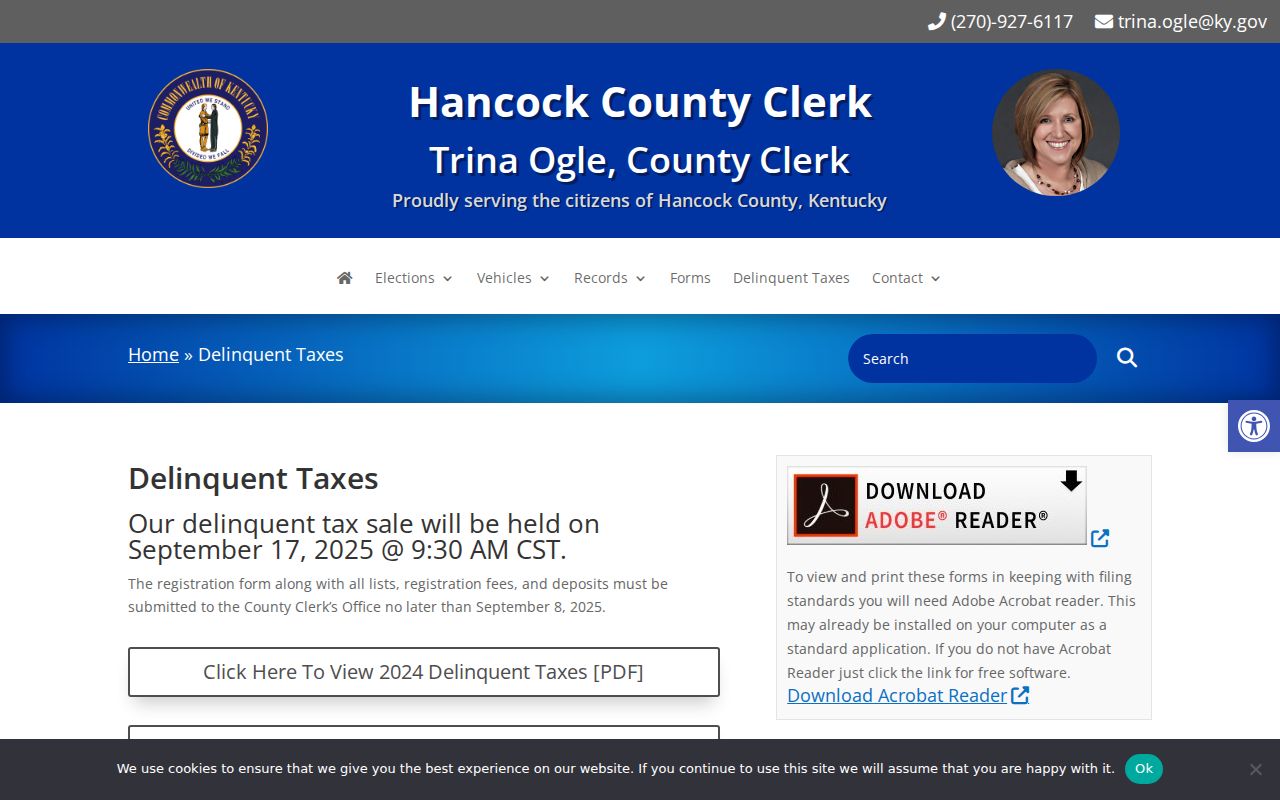
Treat it as the office's front door. Confirm the status of a current certificate with Clerk staff before acting on anything displayed there.
Hancock Exemptions Begin with the PVA
Exemption applications in Hancock run through the PVA under Kentucky rules. The PVA also maintains the assessments those exemptions modify. An exemption changes taxable treatment only. It does not rewrite a deed or set a tax rate. It also does not establish occupancy for every purpose. For the state framework, use the Kentucky Department of Revenue property-tax overview. For the county application and parcel-specific result, use the PVA.
Ask about the current form, eligibility date, supporting documents, and filing method. Confirm the approval appears on the correct roll and parcel. Relief does not transfer automatically. And an older calendar page never replaces the current procedure.
A Delinquent Certificate Is Not a Deed
Hancock County property tax records can show delinquency, a certificate, or sale activity without any completed ownership transfer. The certificate represents a tax claim. The deed index shows recorded conveyances. Court records may document enforcement or related litigation. Keep those sources in sequence.
Confirm the certificate's status with the Clerk before any purchase decision. Examine the Clerk's recorded instruments. Search relevant Hancock court material through Kentucky CourtNet or the Circuit Clerk. A list assembled before a scheduled sale can change through payment, redemption, reassignment, or court action.
The PVA Calendar Needs a Current-Year Check
The PVA opens its roll-inspection period on the first Monday in May. The local Board of Assessment Appeals follows that window. Forms and deadlines shift from year to year. The legacy PVA calendar holds older material, so treat it as a starting point rather than gospel.
The Hancock PVA calendar page is the place to check. It covers orientation and the local contact number. Before you rely on it, confirm the present year's details. Check the conference requirements, appeal form, supporting evidence, filing deadline, and delivery method for any Hancock County property tax records question.
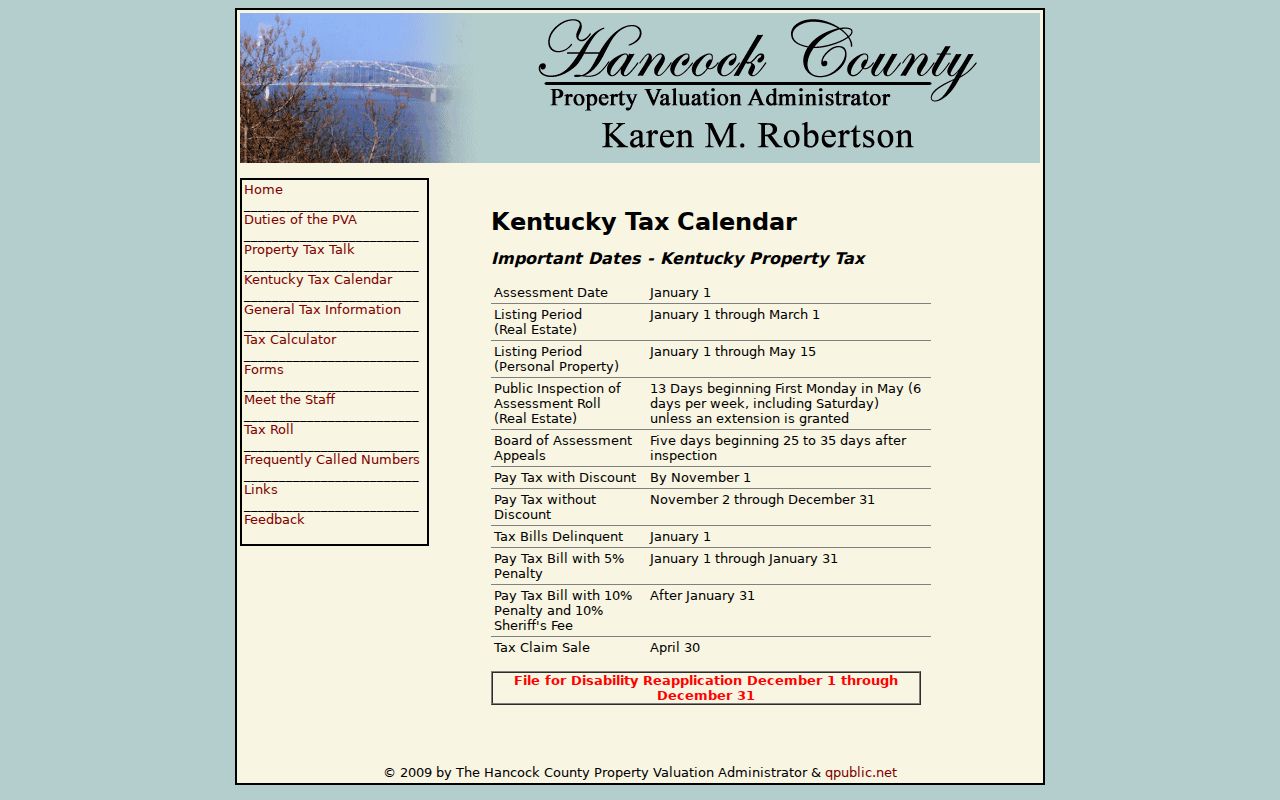
Let it route you to the office. Verify the active year's dates rather than treating a legacy date as permanent.
Compare Value Evidence on the Same Hancock Tax Year
Compare like with like. Before choosing comparable sales, note the valuation date, the tax year, the property class, acreage, improvements, and exemption status on each parcel. A sale from a different year can still help. So can a parcel with a different use or location. But the differences must be explained, or the comparison weakens. Start with the PVA entry itself. Check it for factual errors. An incorrect address, wrong land area, a phantom improvement, or a misstated classification can distort the whole appraisal. Bring photographs, surveys, closing documents, repair records, appraisals, and comparable recorded sales that speak to the disputed value. The PVA can walk you through the county's appraisal. The deed records add the recorded transfer detail. A properly preserved appeal goes to the Board. Keep two cautions in mind. A tax bill is not a valuation by itself, since it folds in the taxable assessment, exemptions, and current levies. A deed's consideration needs context too, because not every recorded transfer reflects an arm's-length market sale.
Verify Every Hancock Tax Payment Demand
Tax-sale urgency draws scammers. Verify the office through its official government page or a published number. Call back on your own. Never hand over a password, a Social Security number, a gift-card payment, or a wire transfer because a caller claims a deadline. Real offices do not work that way. Know what each charge covers. A free public index, a copy charge, a certified copy, a remote record subscription, and professional legal or title work are different things. Each carries a different cost. The Clerk's posted list is informational, and the office sets the amount due at each stage. A deed-copy offer or foreclosure-rescue pitch does not become official just because it quotes a real parcel number. It stays unofficial even with a genuine delinquent bill. Save the official page, the bill year, the certificate year, a contact name, and the confirmation date. Before paying anything, request the current payoff directly from the responsible office. Verify how the funds must be delivered. Tax status changes after a list is published, so an old screenshot never replaces a fresh confirmation from the office.
Contest a Hancock County Assessment on Time
Begin at the PVA conference during the annual inspection period. Gather the parcel record and the valuation year first. Add photographs and corrected measurements. Add comparable sales, and any appraisal or cost evidence that speaks to the disputed value. Ask the PVA which state or county participation document applies. If the issue persists, follow the confirmed procedure for the local Board of Assessment Appeals. Keep proof of delivery plus every decision date. Ownership disputes and deed-description problems belong with the Clerk or a legal professional. An assessment appeal addresses valuation and classification only.
Appeal window. Hancock's roll is inspected for 13 days beginning the first Monday in May, but confirm the current calendar and required forms before filing.