
Hancock County Owner Record Fields
The Hancock Property Valuation Administrator presents the certified tax roll as the place to review tax ownership, assessments, and property traits when available. Its owner line is an assessment record. It carries a roll year, not a title opinion. The live Schneider parcel result does not always open. Until a parcel card loads, capture these fields. Note the owner label, the parcel number, and the roll year whenever the card becomes available.
| Owner name | The tax owner carried on the certified assessment roll. |
|---|---|
| Mailing or in-care-of address | The destination used for assessment and tax correspondence. |
| Situs address | The physical property location, which may differ from the mailing address. |
| Parcel or account ID | The stable search key used to reconcile records that spell names or roads differently. |
| Sale or transfer field | A lead to a recent transaction when the parcel card exposes it. |
| Deed reference | A book, page, or instrument clue to test in the Clerk's recorded index. |
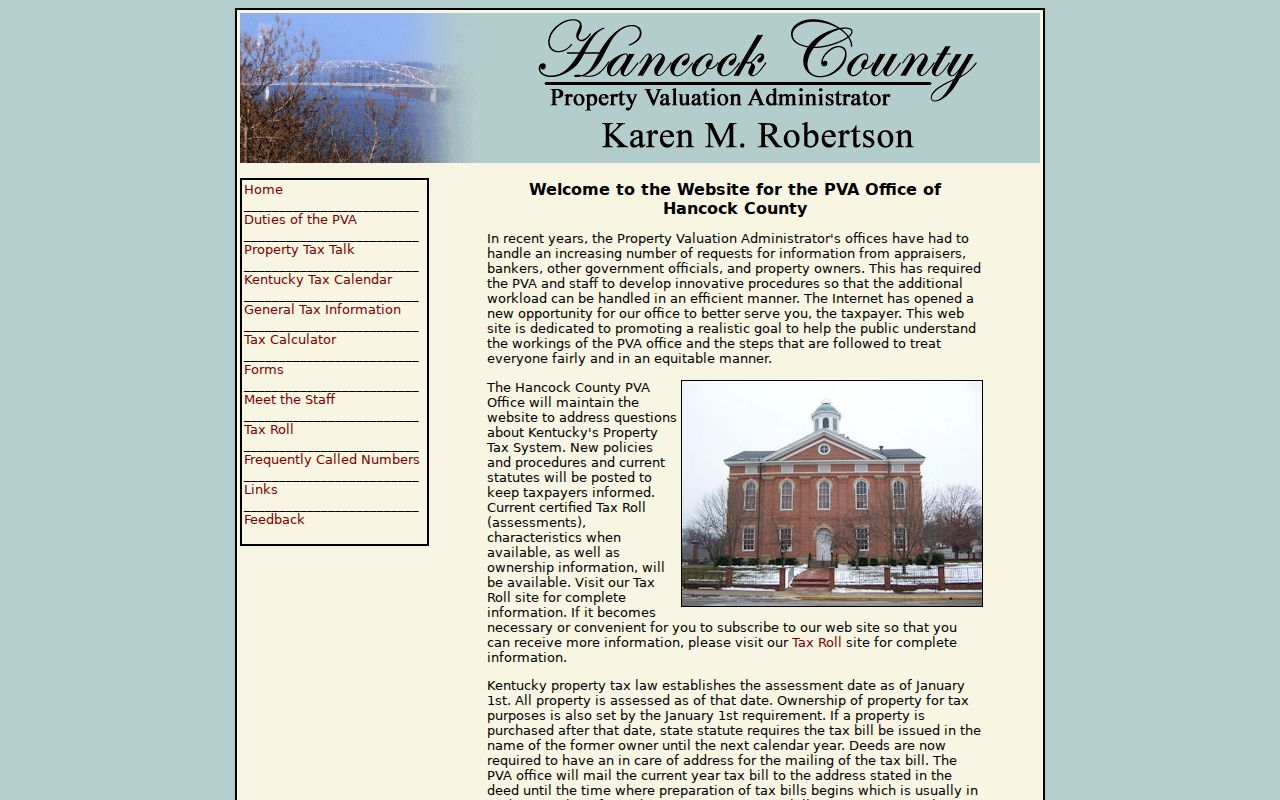
The official Hancock PVA landing page leads to the county's assessment-search gateway even when a live parcel result does not open. Treat it as the starting point.
The PVA portal is the correct starting place. Verify the owner label, parcel ID, and roll year on a live result or with PVA staff. A mailing address does not prove where a person lives. The situs address identifies the land, not its occupant. Hancock County records therefore separate four identities: the recorded title party, the January 1 PVA taxpayer, the tax-bill mailing recipient, and any occupant. The first two can conflict for a valid reason. A recent sale explains most mismatches.
January 1 Sets Hancock Ownership
Kentucky fixes assessment status on January 1. Hancock's PVA warns that a property bought after that date can keep producing a tax bill in the former owner's name until the next calendar year. That alone is not evidence the deed failed. Nor does it mean the office erred. The PVA owner field simply answers a dated tax question about who held the land on the first day of the year.
For a closing later in the year, write down the deed date, the recording date, the roll year, and the name on the bill. A deed to Buyer recorded in autumn can coexist with a January 1 roll naming Seller. Do not silently rewrite the older record. Check the next certified roll again.
Recent-sale check. The newest recorded deed is the more current ownership source when Hancock County's January 1 tax roll still carries the seller.
Tax Owner Versus Deeded Owner
The PVA values real estate and keeps tax-roll ownership. The Hancock County Clerk Legal Records Department records deeds and other title instruments. Those offices do different jobs. An inquiry that needs legal vesting should not stop at the assessment card. Assessment answers come from the roll. The tax bill adds a third view of ownership. Hancock County's Sheriff handles current bills and collection, while the Clerk handles delinquent certificates. A bill may use an in-care-of recipient drawn from deed information, so keep that recipient distinct from the grantee named in the deed.
Note: Ask the PVA for the roll year whenever an owner line is quoted, because “current” without an as-of date can mislead.
Hancock Mailing and Situs Clues
A situs address points to the assessed site. A mailing address tells the PVA or tax office where to send notices. Rural delivery, an out-of-county owner, an estate, or an in-care-of line can make the two differ without changing title. Hancock 911 Mapping assigns physical addresses. USPS governs mailing validity. Neither office records a deed. When an address is unclear, keep the parcel or account ID beside both forms of the address. The Hancock County 911 addressing office can explain an address assignment, road name, or driveway issue, but it cannot cure a missing deed or settle a boundary dispute.
Confirm Hancock County's Current Owner
Verification joins the dated PVA entry to the newest deed affecting the same land. Rely on the parcel number, not a street address. Match the legal description, deed reference, and parties too. Hancock deed indexing and scanning reaches back to 1979. Most filing images from January 2004 forward are available through the Clerk's remote system, though eCCLIX access may require an account or software.
- Open Hancock PVA/qPublic and capture the tax owner, roll year, parcel ID, situs, and mailing fields.
- Use the owner name and deed clue in the Clerk's grantor-grantee index. Select the latest conveyance that matches the parcel or legal description.
- Read the grantee and the form of ownership on that recorded instrument. Check that all pages, exhibits, and prior references are present.
- If dates or names conflict, call the PVA at 270-927-6846 for the assessment record and the Clerk at 270-927-6117 for the recorded instrument.
- Owner of record
- The party named by a specified official record as of its date.
- Assessment roll
- The PVA's dated list of taxable property, owners, traits, and assessed values.
- Situs address
- The physical location assigned to the parcel, distinct from a mailing address.
- Recording lag
- The time between a conveyance, its recording, and a later update to another office's database.
Entity Owners in Hancock County
A current owner may appear as an LLC, corporation, trust, or estate rather than an individual's name. Preserve that exact spelling. For a business, the Kentucky Secretary of State Business Entity Search can show filings and a registered agent. They name the entity and a public contact. They do not prove the entity owns this parcel. A trust may disclose only the trustee or trust name in the public record. An estate can require a deed, affidavit of descent, executor's deed, will, or probate order. The recorded land instrument remains the property link. Court and business records are supporting clues, not substitutes.
When Hancock qPublic Is Blocked
The live Schneider viewer may block a session outright. When that happens, resist guessing at a current owner. Have the street address ready. A parcel or account number helps too, along with the roll year you need. For parcel-specific questions, the PVA office at 225 Main Cross Street in Hawesville can help. Ask by phone. Ask at the counter.
The Clerk's indices and public records stay free to view in the office. Remote images through eCCLIX depend on an account and the right software. A written Clerk request should name the grantor or grantee. It should also give the date range, the instrument or book and page, and the legal description. Hancock's open-records policy also accepts requests by email, fax, mail, and hand delivery. A determination is due within five working days, excluding weekends and legal holidays.
Note: Portal checked September 8, 2026; no live Hancock parcel sample was obtained, so verify field labels with the PVA.
Monitor Hancock Owner Changes
The Clerk offers free DOC ALERT notifications for a personal or business name. These fire whenever a deed or mortgage is recorded. Treat it as a monitoring aid. It works best after the current owner has been identified. An alert does not validate the filing or resolve a name collision. It also cannot replace review of the actual instrument.
Use the precise owner or entity spelling found in the deed. When an alert arrives, compare its details against the known parcel. Check its document type, parties, recording date, and property description. This forward-looking check is especially useful for catching an unexpected deed or mortgage entry. Just avoid treating every same-name filing as a match.
Contact a Hancock Current Owner
The public mailing or in-care-of field can offer a lawful route for a property-related letter. Address the entity or owner exactly as the official record does. State the parcel or property at issue plainly. Do not assume the mailing recipient occupies the site. And do not merge unrelated voter, court, registry, or license systems into a personal profile.
Kentucky Safe at Home substitutes addresses and forwards mail for protected participants, though real-estate holdings sit outside the program's general address shield. Even when a property address stays public, restraint still matters. Use only the facts needed for a boundary, deed, sale, estate, or civic question. Nothing more.
Lawful use. A Hancock County owner record may support legitimate property research. Never use an address or owner name to harass, threaten, or target a person.