
Run a Hancock County Property Search in Five Steps
Begin with the Hancock Property Valuation Administrator's qPublic page. That page identifies the PVA's certified assessment roll as the official source. It also points to the current Schneider search. Treat that tool as a live application. Its layout can change. A blank or failed page never means the record itself is missing. Keep the Clerk and office channels ready.
- Enter the situs address, owner name, parcel number, or alternate identifier in the PVA search.
- Open the assessment entry and copy the parcel identifier, tax owner, mailing address, value year, and legal-description clues.
- Carry the owner's exact indexed name to the Hancock County Clerk Legal Records Department and locate the newest deed.
- Compare the deeded grantee with the January 1 tax owner, then consult Kentucky GeoNet or a recorded plat for geography.
- Request the full instrument from the Clerk when an image is gated or legal reliance requires an official copy.
Each step answers to a different custodian. The PVA maintains the assessment data, the Clerk records land instruments, and the Sheriff collects current tax payments. Delinquent tax certificates go back to the Clerk as well.
Hancock qPublic Search Fields and Known Limits
Four useful entry modes appear in the accessible qPublic material. The current Schneider interface is a live application. Its layout and fields can shift at any time, while the certified roll remains the PVA's official assessment source.
| Field | Useful input | What to verify |
|---|---|---|
| Owner name | Surname, full name, estate, trust, or entity | Spelling and tax-owner date |
| Address | Street number and name | Situs versus mailing address |
| Parcel | The PVA parcel identifier | Exact displayed format |
| Alternate ID | An identifier already found on a record | Whether it matches the same tract |
Hancock County's exact parcel-number format is not published. Copy the identifier exactly as displayed instead of constructing one from Kentucky's FIPS or road-data conventions.
When the Hancock County Portal Will Not Open
A dead portal is a detour, not a dead end. The County Clerk lets anyone inspect indices and public records free at 225 Main Cross Street in Hawesville. Remote eCCLIX images require an assigned account and software access. Written open-records requests can go by email, fax, mail, or hand delivery under the Clerk's open-records policy, which promises a determination within five working days followed by inspection or copies.
Contact the Hancock PVA for the certified roll. Older property history lives in the Hancock County Archives at the Old Courthouse, where court and deed material reaches back to 1829. Bring an address and any known names. An approximate date and any book/page reference help too.
Note: Office inspection may reveal index detail or older material that is absent from the remote image service.
Read a Hancock County Property Search Result
Every result is a set of clues. It belongs to one custodian and one date. The PVA entry speaks to assessment, the deed index speaks to recorded instruments, and a complete review keeps those roles separate.
| Tax owner | The name associated with the January 1 assessment roll; it may lag a later purchase. |
|---|---|
| Situs and mailing address | The physical location and the separate destination for owner correspondence. |
| Parcel number | The assessment key to copy into related property-search channels. |
| Assessment | The certified tax-roll value and its relevant year, not a guaranteed sale price. |
| Legal-description clue | Lot, block, tract, subdivision, or deed references that lead to the full instrument. |
| Recorded transfer | Grantor, grantee, recording date, deed type, and book/page or instrument reference when available from the Clerk. |
The PVA warns about one trap. Buy after January 1 and the former owner stays on that year's tax bill. Check the latest deed before calling it an error. A map polygon is just as limited, since it helps locate the tract but never replaces the deed, the recorded plat, or the survey.
Tax Owner, Deeded Owner, and Mailing Name
The January 1 rule creates a reconciliation problem. The deed names the grantee who took the recorded interest, while the PVA roll names the tax owner as of the assessment date. The tax bill may add an in-care-of mailing name or address. So a recent buyer can sit in the deed index while an older name rides the bill. That lasts until the following calendar year.
Write down each name, source, and date. Estates need wider searching. Run the decedent, executor, heirs, and any “Estate of” name through the deed index and Kentucky Judicial Indexes. An LLC brings its own wrinkle. Confirm its exact legal spelling through the Kentucky Secretary of State business search before heading back to the Clerk index.
The 1979 Line in Hancock Deed Searching
The Clerk indexes and scans deeds back to 1979. Most images filed from January 2004 forward are online. Those dates explain an odd result. A name search can surface an index entry with no viewable image, and the older chain waits in deed books and indices at the Clerk and the Archives. A full ownership history may simply leave the web.
Mortgage coverage deserves extra caution. The Clerk's own records page lists both 1971 and 1974 as starting years. Until the office confirms which is right, keep both dates rather than picking one. The lesson is that remote access, index coverage, and image coverage are three different things, and the “everything is online” myth breaks down fast in Hancock County.
Use the Official 911 Address as a Search Bridge
Rural delivery names, postal cities, city limits, recorded descriptions, and the PVA situs can all disagree. One office sorts it out. Hancock County 911 Addressing assigns and maps new addresses, researches the property and driveway after an online request, and shares the result with the assessor. A self-assigned or Google address may be flat wrong. Most requests take up to ten business days.
A blank address search is fixable. Drop the directional abbreviations, search the street name alone, try the owner, and compare the official 911 form or parcel reference. USPS ZIP lookup confirms mailing geography. But a postal city proves neither municipal limits nor parcel identity.
Maps Help a Hancock County Property Search, but Do Not Finish It
Hancock County offers no official parcel GIS viewer of its own. For map context, Kentucky GeoNet supplies statewide open data, imagery, elevation, and metadata, while qPublic carries the county assessment route. A river tract or rural parcel can be oriented this way. Then pull the recorded plat or the deed description from the Clerk for certainty.
Maps can mislead, though. River shifts, old roads, and changing city boundaries all make an apparent match shaky. A PVA sketch, a GIS polygon, a recorded subdivision plat, and a professional survey are not the same thing, and the parcel page breaks down that difference.
Choose Address, Owner, or Parcel for Hancock County
Every property search in Hancock County starts with the one detail you already hold. Pick the key that fits what you know, then pivot to a stronger identifier, such as a parcel number, the moment the official result hands you one.
| Search Key | Best For | Where It Works | Watch Out |
|---|---|---|---|
| Address | Finding one known location | PVA and 911 | Postal city, rural route, and situs can differ |
| Owner name | Finding assessed parcels or indexed instruments | PVA and County Clerk | Estates, entities, initials, and spelling variants |
| Parcel number | Carrying an exact assessment key | PVA and related tax work | Do not infer the unverified Hancock format |
Not a title search. A Hancock County property search reveals assessment and recorded clues, but it does not guarantee clear title or identify every unrecorded interest.
Monitor New Hancock Deeds with DOC ALERT
The County Clerk runs DOC ALERT, a free notification service that flags a deed or mortgage recorded under a personal or business name you supply. It earns its keep after a purchase. It also works well for watching an entity-owned parcel. The alert points to a future filing that deserves inspection.
Know what the alert is not. It does not validate an instrument, block recording, or settle title. Follow the notice back to the official Clerk record, confirm the parties and the legal description, and call the office through its published number if an unexpected filing appears.
The PVA landing page is the county-specific assessment gateway. Use the Hancock PVA qPublic source directly. Commercial listings and other states' Hancock County results will only muddy the property search.
Inspect the Hancock PVA Entry Before Pivoting
The PVA landing page is the county-specific assessment gateway. Use the Hancock PVA qPublic source directly. Commercial listings and other states' Hancock County results will only muddy the property search.
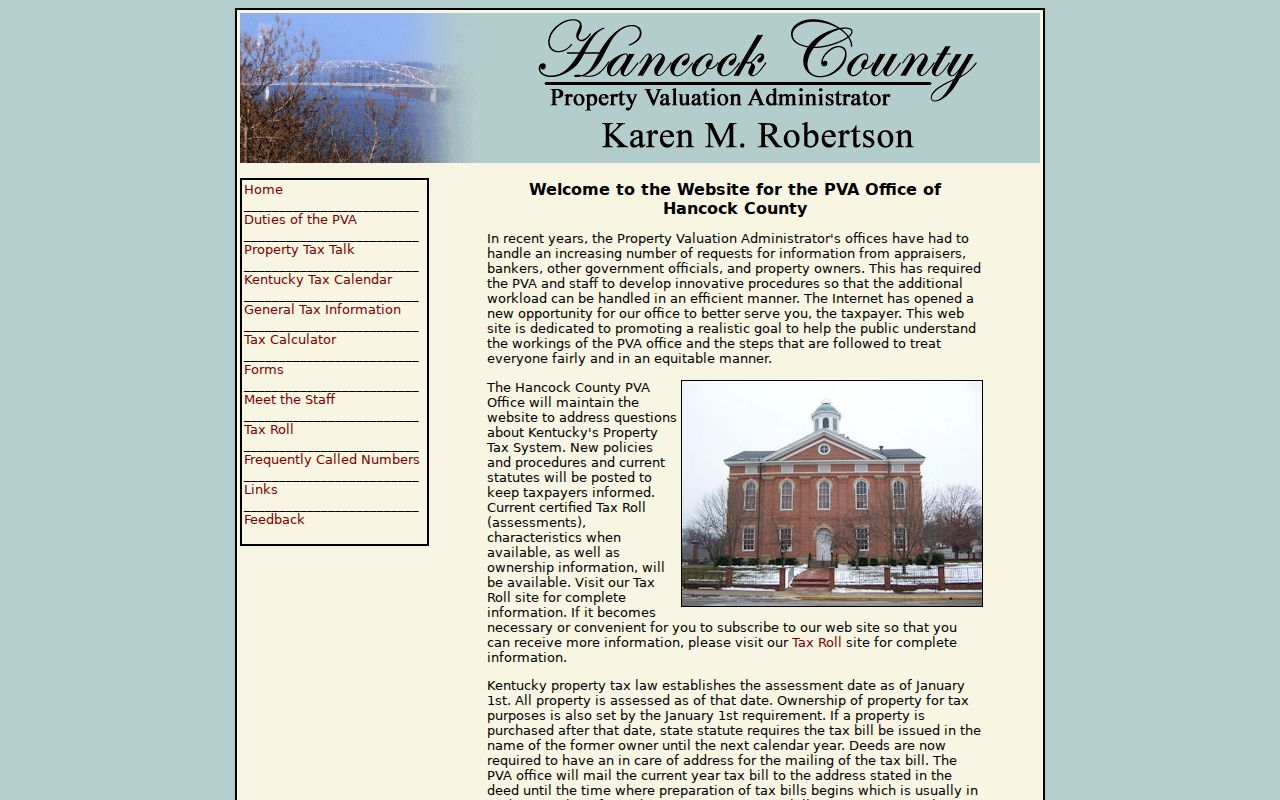
The official route runs through the assessment entry. Its ownership details reflect January 1 of each year. The Schneider search itself can be blocked. Treat the entry as a guide to fields rather than a verified live parcel. A successful result is worth saving. Print the page and note the access date. Copy the owner spelling, situs, mailing address, parcel ID, assessment year, characteristics, and deed-reference clues exactly as shown. Keep each field separate. A structure description can support appraisal work, but it does not prove a building's condition. A legal-description snippet may point toward a deed or plat. Yet it never replaces the full recorded description.
Write a Reproducible Hancock Records Request
Custodians answer best when a request names records plainly. Ask for records, not for a legal conclusion. For the Clerk, list instruments by grantor, grantee, recording date, book/page or instrument number, and document type. Include the legal description too, all within a reasonable date range. For the PVA, name the parcel or account, roll year, displayed owner, value, and characteristics. For 911, use the current address form. Attach the parcel, map, or plat material the office confirms it needs. Say whether inspection, an ordinary copy, or a certified copy is wanted. Include contact information and keep a copy of the submission. The Kentucky Open Records Act, KRS 61.870 through 61.884, governs access but carries exemptions too. The Clerk's policy promises a determination within five working days. It does not promise that every broad question can be answered as phrased.
An index entry is still a start. Use it to sharpen the next request. Supply the newly learned recording reference. Ask whether an image, deed book, plat, release, or exhibit is held. For an older chain, give each former owner's spelling and an approximate transfer window. For a rural tract, use the modern road address. Pair it with the description clue in the latest deed. This step-by-step approach cuts false matches. It also leaves a clear trail from a public index to the underlying source in the Hancock County property search.